

Riccardo Rosa, president of UCIMU : "Domestic demand, which is completely stalled, is once again being hit by the 'wait-and-see' effect of incentives."
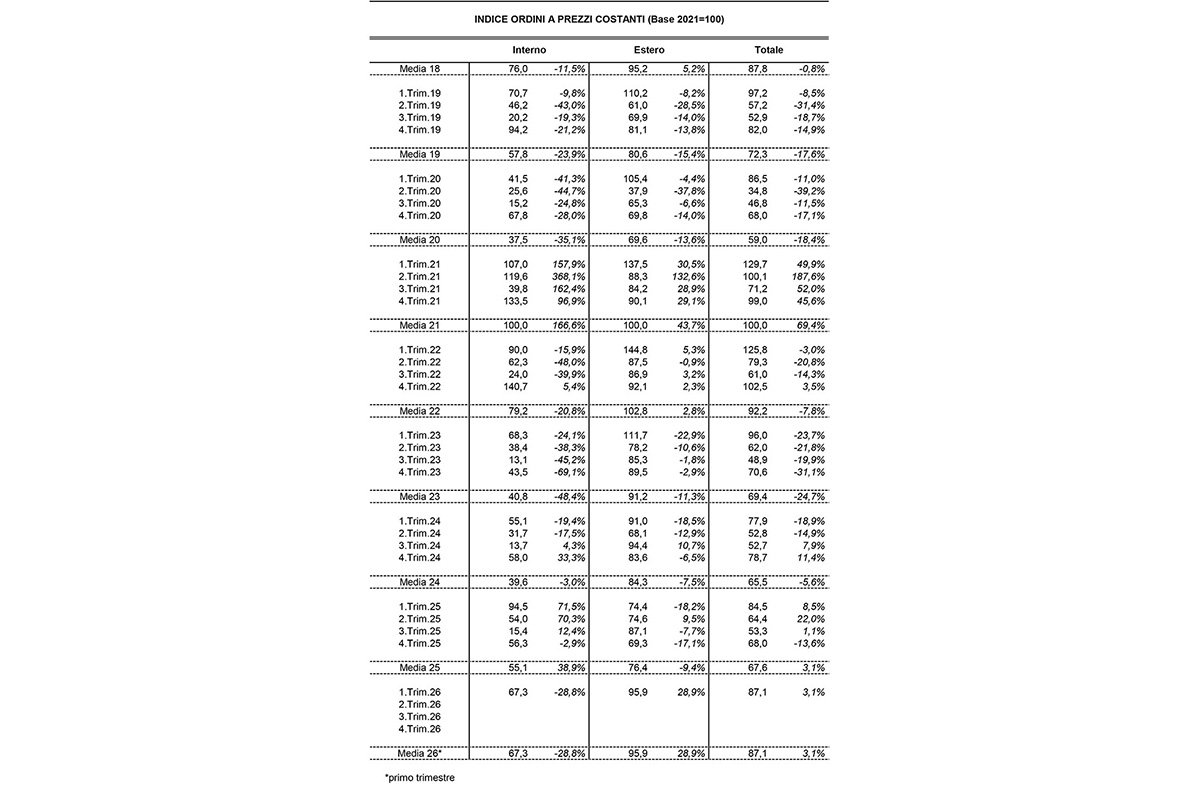
In the first quarter of 2026, the machine tool orders index compiled by the UCIMU-SISTEMI PER PRODURRE Study & Business Culture Centre showed an increase of 3.1% compared to the January-March 2025 period . In absolute value, the index stood at 87.1 (base 100 in 2021).
The result was determined exclusively by the manufacturers' good performance on the foreign market; on the other hand, the collection of orders on the domestic market was decidedly negative.
In particular, orders collected across borders marked an increase of 28.9% , compared to the first quarter of 2025, for an absolute value of 95.9.
Conversely, order intake in Italy decreased by 28.8% compared to the same period of the previous year. The absolute value of the index stood at 67.3.
Riccardo Rosa, president of UCIMU-SISTEMI PER PRODURRE, stated: "The first-quarter order index is growing, and this is certainly a positive figure, but absolutely not satisfactory for Italian manufacturers. Exports are booming, but for how long? Meanwhile, Italy is stuck at the mercy of government authorities' announcements regarding hyper-depreciation, which, just as happened with Transition 5.0, are slow to arrive."
The increase in cross-border activity, despite the climate of geopolitical instability we face daily, demonstrates the ability of Italian manufacturers to capture demand where it can most easily materialize, focusing on the areas and sectors most likely to invest. This is an important and meticulous effort that our companies have been carrying out for several months now, leveraging all the opportunities and knowledge available to them. And since foreign demand is still being met despite everything, it seems even more evident that the stalled domestic demand is due to the wait for clarification on the hyper-depreciation measure.
"How is it possible to find ourselves in the same situation as in 2025, hanging on to the constant announcements and retractions of our government authorities? As it was conceived," continued Riccardo Rosa, "the hyper-depreciation measure should support innovation in our industry, but instead it forces companies to wait, suspended between an implementing decree and a ministerial decree, effectively freezing negotiations, which are currently numerous. In short, Italian users are willing to invest, but nothing will move until all the technical details of the measure are communicated."
"We warmly welcomed the government's decision to equip the manufacturing system with a measure, such as hyper-depreciation, with a multi-year implementation period, from 2026 to 2028. But," Rosa notes, "this wait, which will effectively extend well into the first half of 2026, has immediately brought us back to the truly frustrating experience of Industry 5.0."
"The point is that the manufacturing world, as Confindustria President Emanuele Orsini has already stated, is not only concerned about the geopolitical context but is also disheartened by the slow pace of action by government representatives, both nationally and at European level."
"This quarter," Rosa stated, "Italian manufacturers have received orders thanks to foreign demand, despite all the difficulties we mentioned earlier. But what would happen if the conflict in Iran were to continue? It would no longer be a matter of facing a total or partial market closure. Instead, we would be faced with a much worse situation. For this reason, it is crucial to immediately implement all the necessary measures to implement the hyper-depreciation incentive, thus enabling Italian companies to make the investments they intend to plan and which are currently on hold."
"Furthermore," concluded the UCIMU president, "we ask government authorities in Europe to champion the need to rely on a strong Union, determined to define shared policies and programs that will allow us to best address global geopolitical instability before it overwhelms us."

 Industriale.it certification