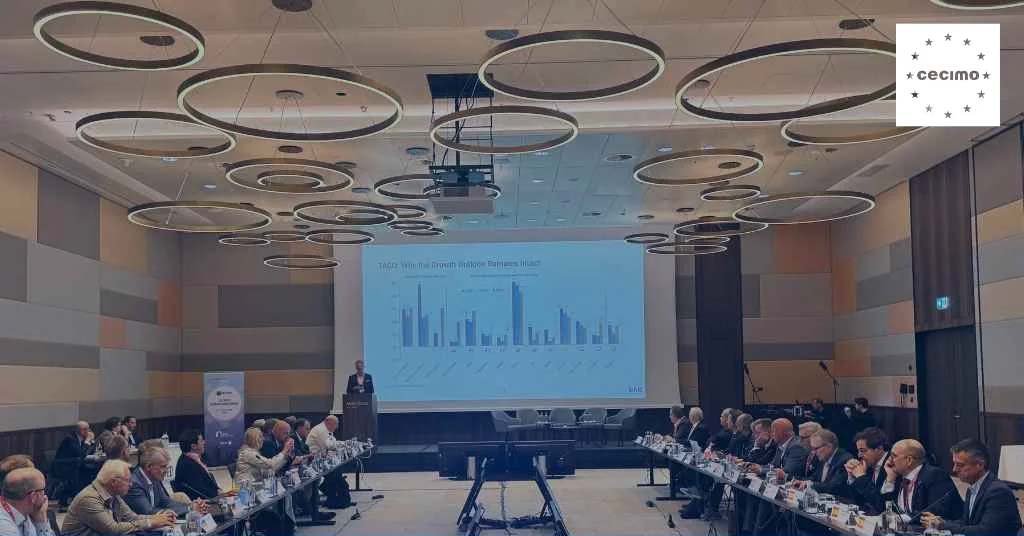
CECIMO examined the challenges the sector will face in 2026 and discussed future risks and opportunities, in a context still characterized by political and economic uncertainty.
Economic situation and prospects
In 2025, the European machine tool sector continued to face a challenging economic environment, with weak demand and increased global competition putting pressure on CECIMO member companies. European machine tool production is estimated to have decreased by approximately 6.6% compared to 2024, reaching €23.5 billion, demonstrating that the slowdown has yet to ease.
This trend is also impacting Europe's position in the global market. In 2025, Europe's share of global machine tool production fell to approximately 30.8%, almost 2 percentage points less than the previous year. This trend is particularly worrying when compared to 2023, when Europe accounted for 33.4% of global production. This means that Europe has lost almost 3 percentage points of global production share in just two years, indicating a gradual erosion of its "industrial position."
Furthermore, the European machine tool market showed clear signs of weakening when considering consumption levels, which decreased by 3.7% compared to 2024, reflecting lower demand across European countries. Trade flows also declined: exports by European machine tool manufacturers decreased by 8.8%, while imports fell by 4.2%. The main export destinations for European machine tool manufacturers (excluding Europe) are the United States, China, and India. At the same time, when looking at European machine tool import flows, Japan, China, and South Korea continue to be the most significant suppliers.
Overall, these developments confirm that the sector has been operating in a challenging economic environment, impacted by slowing investment, persistent uncertainty, geopolitical tensions, and weakening momentum in both European and global markets. Taken together, these factors have reduced demand for machine tools and negatively impacted the operating conditions of CECIMO members.
A similar picture emerges when looking at the order levels of the CECIMO8* index. Domestic orders decreased by approximately 1.7% in 2025 compared to 2024, marking the third consecutive year of contraction. By contrast, foreign orders increased by 1.2% over the same period, marking the first year of growth after two consecutive years of decline.
CECIMO's projections for 2026 indicate a modest improvement after two consecutive years of declining production and consumption in the European machine tool sector. Consumption and production levels are expected to increase in European countries, suggesting a possible stabilization. CECIMO's estimates for orders indicate an improvement in overall order volumes in the CECIMO8 index countries in 2026. However, this outlook remains fragile and exposed to external shocks and general market conditions and should therefore be interpreted as a transition phase rather than a full recovery.
The sector will continue to operate in a highly uncertain environment, characterized by geopolitical tensions and conflicts, trade risks, potential tariff measures, energy market volatility, and weak investment dynamics in major European economies. Since European machine tool manufacturers remain highly exposed to international trade and industrial investment cycles, any deterioration in these conditions could limit the expected recovery and potential future recoveries.
At the same time, CECIMO sees potential support from positive spillover effects related to public investment and strategic sectors such as defense, aerospace, electrification, artificial intelligence technologies, and advanced engineering. These sectors could help support demand for advanced and high-precision manufacturing solutions, but their impact will depend on timely implementation and avoiding further delays.
A stable trade environment, increased industrial investment, and effective policy measures could mark the beginning of a gradual recovery for the European machine tool sector. Without these conditions, Europe risks further weakening its position in machine tool technologies, while global competitors continue to strengthen their industrial capabilities.
"The current situation confirms that Europe cannot take its industrial leadership for granted. European machine tool manufacturers continue to operate in a challenging environment, characterized by declining demand, persistent global uncertainty, and growing competitive pressure. While some opportunities may emerge in strategic sectors, Europe needs a stable policy framework, increased industrial investment, and faster implementation of measures to support advanced manufacturing," commented François Duval, President of CECIMO.
Metal show & tib evolves with the market and becomes digital metal & tib
The market demands digitalization, and ROMEXPO is responding with a major strategic repositioning. Starting with the 2027 edition, the METAL SHOW & TIB trade fair becomes DIGITAL METAL & TIB, an important step for the entire industry and a clear signal of alignment with international standards in the sector.The decision stems from ongoing dialogue with exhibitors and partners over previous editions, whose market signals were clear: the metal industry can no longer be viewed separately from the digital transformation that is redefining production chains, maintenance, logistics, and business models globally today. We listened to this message and rethought the event concept from the ground up — not just as a rebranding, but as a fundamental repositioning of the target audience, the exhibition content, and the value proposition for participants.DIGITAL METAL & TIB aims to become Romania's reference platform for companies undergoing digital transformation, including industrial automation, robotics, predictive maintenance, Industry 4.0, systems integration, and software solutions for production. This is a natural alignment with the direction already adopted by major European trade fairs in the field, and an opportunity for local players to remain competitive in an increasingly internationalized market.A key element of the new concept is the convergence between the metal community and the TIB community. The two ecosystems, complementary by nature, will operate under a single umbrella brand, with an integrated exhibition format, shared thematic areas, and a networking program specifically designed to facilitate cross-industry partnerships."We have closely followed feedback from companies over recent editions, and we clearly understood the direction: the industry needs an event that speaks the language of digitalization, not just product display. DIGITAL METAL & TIB is our answer to this need — a format built for today's company: connected, technologically advanced, and oriented toward international standards," says Oana Netbai, Commercial Director of ROMEXPO.The rebranding, in fact, marks the maturation of an entire exhibition segment. DIGITAL METAL & TIB will bring together manufacturers, technology suppliers, systems integrators, and industry specialists in a setting dedicated to innovation, know-how transfer, and cross-sector collaboration, positioning Romania closer to the trends shaping the industry globally.ROMEXPO organizes the event, and it will take place from May 11–14, 2027, at ROMEXPO, Bucharest. Interested companies are invited to budget early for their participation in DIGITAL METAL & TIB to benefit from the best exhibition conditions and optimal positioning within the event's new concept.
 Industriale.it certification