

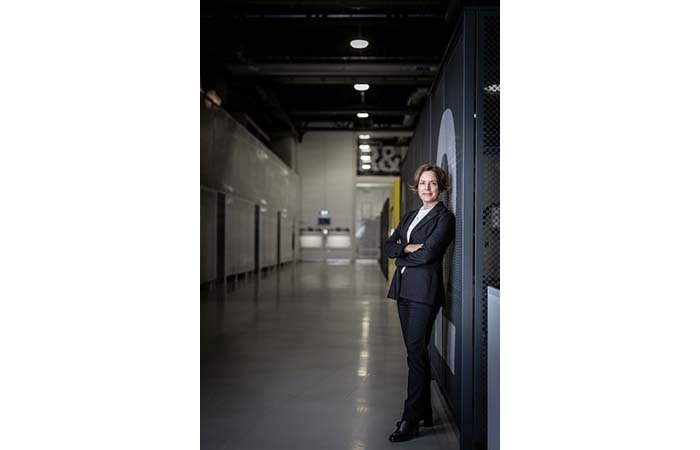
2026 has begun, and transformation across all industries is accelerating. Sustainability, digitalization, and talent development are now firmly at the top of the manufacturing agenda, redefining the way companies operate and compete. Against this backdrop, Helen Blomqvist, President of Sandvik Coromant, reflects on more than 80 years of market leadership in the cutting tools industry and the forces that will shape the years to come.
We build the future on the foundations of our heritage
Sandvik Coromant's position as a global leader in cutting tools and manufacturing solutions is rooted in its history, but it is also firmly oriented towards the future. At a time when transformation is at the top of the global agenda, we actively support customers around the world, helping them navigate change and seize new opportunities.
Leadership in a changing world requires clarity of direction without losing sight of our roots. Even with a strong brand and a proud history, we cannot rest on our laurels; we must strive to grow and be effective today, while simultaneously transforming our capabilities to remain the undisputed market leader tomorrow.
A key part of this approach is creating a culture of learning. Psychological safety and curiosity are essential, and it's crucial to create an environment where people feel safe to experiment with new ideas. High-performing and empowered teams, with a strong customer-focused mindset, are at the heart of how we translate strategy into action. Eliminating the fear of failure, combined with curiosity and a strong customer focus, is essential to moving forward.
A sector in full transformation
The manufacturing sector is experiencing a rapid technological leap. But it's important to recognize that this represents an opportunity, rather than a threat. The sector is undergoing significant change, with customers at different stages of the journey. Sustainability, digitalization, severe cost pressures along the entire value chain, and the skills gap are the trends characterizing this shift.
This is particularly evident in sectors like aerospace, where growth is driven by the demand for lightweight structures, next-generation engines, and greater fuel efficiency. These requirements are accelerating the adoption of advanced materials like titanium and heat-resistant superalloys, pushing manufacturers to invest in more sophisticated processing technologies.
Market forecasts, such as those detailed in the Deloitte 2026 Aerospace and Defense Industry Outlook, point to a new era of growth, with global aircraft production accelerating thanks to recovering passenger demand, intensified fleet modernization, and the beginning of OEMs' clearing of long-standing backlogs. At the same time, defense and space programs continue to expand, creating sustained demand for high-performance materials and precision components. Together, these forces are driving one of the strongest production cycles the aerospace industry has seen in over a decade.
AI as a strategic driver for people and production
Artificial intelligence is moving beyond experimentation to become an essential tool. Across industries, leaders are integrating AI into operations, supply chains, purchasing, and quality control.
Sandvik Coromant has recognized this for several years and has a dedicated AI team focused on getting the most out of the technology. The organization isn't alone in this: data from Xometry's Manufacturing Outlook 2026 reveals that 82% of executives consider AI a key growth driver, with nearly half already reporting significant ROI.
Artificial intelligence has moved beyond the hype stage to become a fundamental tool for manufacturing, and its adoption is expanding in critical areas such as supply chain, purchasing, and quality control. Looking to the future, we can expect AI systems to be fully integrated into smart factory operations. Machines will learn and adapt in real time, intelligently optimizing production parameters, reducing waste, and proactively scheduling maintenance.
Looking ahead, the manufacturers that will succeed in 2026 will be those that treat AI not as a standalone technology, but as a strategic capability woven into culture, processes, and leadership, leveraging data and automation to unlock new levels of efficiency, resilience, and customer value. Used responsibly and transparently, AI will be a critical driver of productivity, sustainability, and long-term competitiveness across the entire manufacturing ecosystem.
Sustainability translated into action
It's difficult to look at the future of manufacturing, both short and long-term, without considering its impact on our planet. "We can choose to lead or be led to ruin," said United Nations Secretary-General António Guterres at the opening of the COP30 climate conference held in Belem, Brazil, in November. "Choose speed, scale, and solidarity. Choose to make this moment a turning point. Stand up for science. Stand up for justice and future generations," he urged.
His words reflect a truth the industry can no longer ignore: sustainability is not optional, but a determining force in the way manufacturers operate. What matters now is the ability to translate ambition into concrete, scalable initiatives that deliver real environmental and commercial value, especially at a time when the prices of critical raw materials like tungsten and other metals are rising sharply, putting further pressure on manufacturers' cost structures.
At Sandvik Coromant, this shift is already underway. One example is our buyback program, which allows customers to sell used carbide tools back to us for recycling and circular production. In a market where raw material prices are rising significantly, circular solutions like this help both customers and suppliers reduce exposure to volatile input costs while strengthening long-term resource security.
Supported by a digital portal, the program simplifies logistics, pricing, and CO2 reporting, while reducing the need for virgin raw materials. It transforms circularity from a concept to a practical, everyday process in the workshop. We are also developing similar digitalized processes for our remanufacturing offering, enabling customers to maximize their inventory and leverage easy-to-use self-service platforms, improving efficiency, extending tool life, and supporting margin resilience in an increasingly cost-constrained environment.
Another important initiative is the Sustainability Analyzer, which we launched in 2025. Through this tool, our team can clearly demonstrate the CO2 reductions customers can achieve by using more efficient processing solutions, making sustainability measurable and actionable in investment and production decisions.
Looking ahead to 2026, sustainability will be increasingly data-driven and integrated into core manufacturing workflows. Customers will expect transparent carbon metrics along with performance and costs, and suppliers will be judged on their ability to support decarbonization across the entire value chain. Digital tools will play a central role in enabling this shift, transforming environmental impact into a shared and quantifiable responsibility.
Looking to the future
Customers are already starting to expect more than just the products they buy. They're looking for solutions that create value through strategic partnerships, digital innovation, and a shared commitment to sustainable manufacturing.
Sandvik Coromant is strongly positioned for the future, combining today's performance with tomorrow's transformation, serving as both a natural partner in industrial matters and an employer of choice. Contributing to learning, innovation, and building strong teams is the hallmark of success.
Sandvik Coromant
Together with customers and partners, Sandvik Coromant paves the way to a sustainable future and provides tooling solutions to mechanical engineering industries worldwide. Over eighty years of practical experience have allowed us to build a wealth of knowledge in metal cutting and machining. This expertise transforms every challenge into an opportunity for innovation, collaboration, and cutting-edge solutions. Our goal is to pursue positive change by promoting sustainability, efficiency, and growth to shape a future where innovation is at the forefront. Part of the global industrial engineering group Sandvik, Sandvik Coromant is committed to building the future, together with its customers.
Allegro microsystems introduces 48v power and precision sensor solutions for physical ai in humanoid
The new devices address critical challenges of size, weight, and safety in humanoid robots. Collaboration with Sarcomere Dynamics makes near-human dexterity possible.Allegro MicroSystems, Inc. (“Allegro”) (Nasdaq: ALGM), a leading global provider of power and sensor solutions for motion control and energy-efficient systems, expands its robotics portfolio with precision sensors and 48V power architectures. The new solutions address some of the key hardware challenges of Physical AI: torque density, thermal management, and functional safety in human-robot collaboration.Key innovations in the portfolio include: 48V power integration:The A81481 power management integrated circuit (PMIC) reduces overall system footprint and hardware costs by 50%, accelerating time to market for robotics OEMs.Precision in high-torque joints: The A17802 and A17803 inductive position sensors are immune to stray magnetic fields, requiring no additional shielding, and tolerate air gap variations. Dexterity in microjoints: The XtremeSense™ TMR CT310 angle sensor and the A33023 Hall-effect angle sensor offer sub-degree accuracy and are a compact alternative to traditional resolvers and optical encoders. “Precise motion control, accurate measurement, and efficient power management are critical for advanced robotic manipulation applications,” said Harpal J.S. Mandaher, CEO and co-founder of Sarcomere Dynamics Inc., said, “We are proud to collaborate with Allegro to integrate their advanced motion controllers, sensors, and power ICs into our Scorpion robotic gripper. This collaboration will continue with our next-generation ARTUS Dex, a 24-degree-of-freedom (DoF) robotic hand designed to deliver human-like dexterity in advanced physical AI applications.” Single-Chip PMIC Simplifies 48V Power Supply for RobotsHumanoid robots are increasingly adopting 48V architectures, which reduce wiring weight and limit resistive losses. Designers, however, face the challenge of safely stepping down higher voltages into very compact packages. Allegro addresses this need with the A81481 integrated circuit, drawing on decades of experience in the automotive industry. The A81481 is a 48V PMIC integrated into a single chip, designed for safety-critical robotic applications. It manages the power and safety functions of the entire system directly from a 48 V bus, without the need for external pre-regulators. The device integrates two buck (step-down) regulators, five low-dropout (LDO) outputs, and ASIL-D-compliant safety diagnostics, including a triple-watchdog architecture, all in a compact 6 × 6 mm package. The A81481 powers distributed sensor arrays and simplifies board layout. It also reduces both the overall system footprint and bill of materials (BOM) costs by approximately 50%. Sub-degree angular accuracy for smooth, natural motion. In high-torque actuators, such as those in shoulder, hip, and knee joints, the A17802 and A17803 inductive position sensors ensure precise and reliable measurements even under the most demanding motor control conditions. The A17803 sensor is also available in an ultra-compact QFN package. Thanks to on-chip compensation and advanced filtering techniques, both operate reliably across varying air gaps. Their inherent immunity to stray magnetic fields also eliminates the need for costly shielding. To meet the more stringent mechanical constraints of robotic hands and fingers, the XtremeSense™ TMR CT310 and Hall-effect A33023 sensors better withstand contamination, mechanical shock, and runout—factors that can compromise the performance of traditional encoders. The CT310 offers sub-degree accuracy in a 2 × 2 mm DFN package. The A33023 adds low latency, immunity to stray magnetic fields, and multiple digital output options, making it well-suited for applications requiring robust diagnostics and support for functional safety requirements. “For fixed-mount industrial robots, weight and space are less stringent because they can use larger cables, large external drives, and liquid-cooled systems,” said Andreas Friedrich, Senior Director of Technology & Strategy at Allegro MicroSystems. “In autonomous humanoid robots with more than 30 degrees of freedom, however, every gram and millimeter counts. We combine native 48V power management, robust motor and gate drivers, inductive sensors immune to stray magnetic fields, and compact TMR sensors, offering robot designers integrated, modular solutions ready to meet safety requirements. This allows them to maximize torque, manage tight mechanical tolerances, and achieve smooth motion.”
 Industriale.it certification