
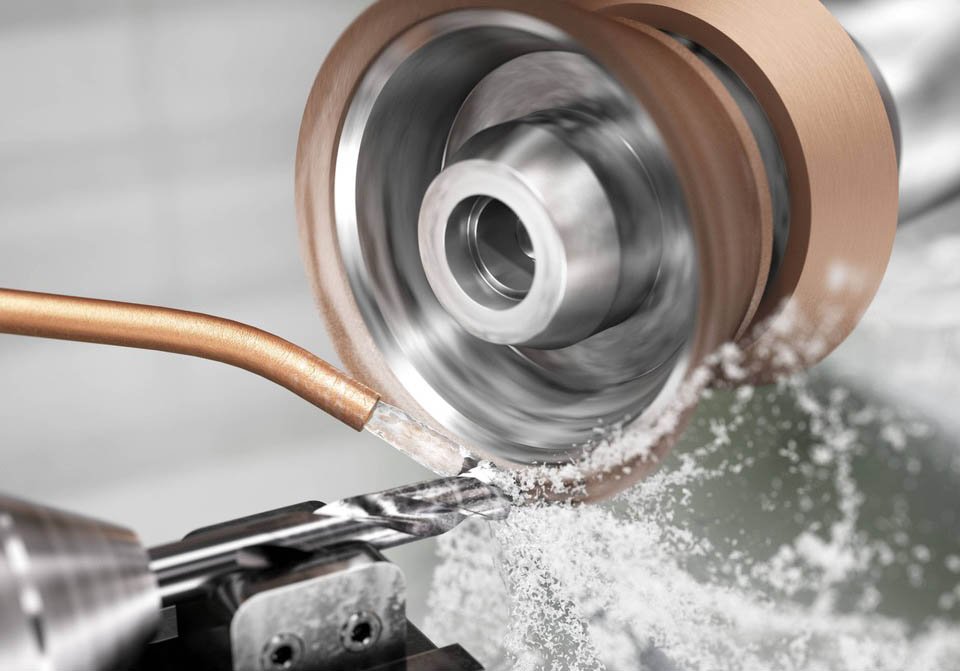
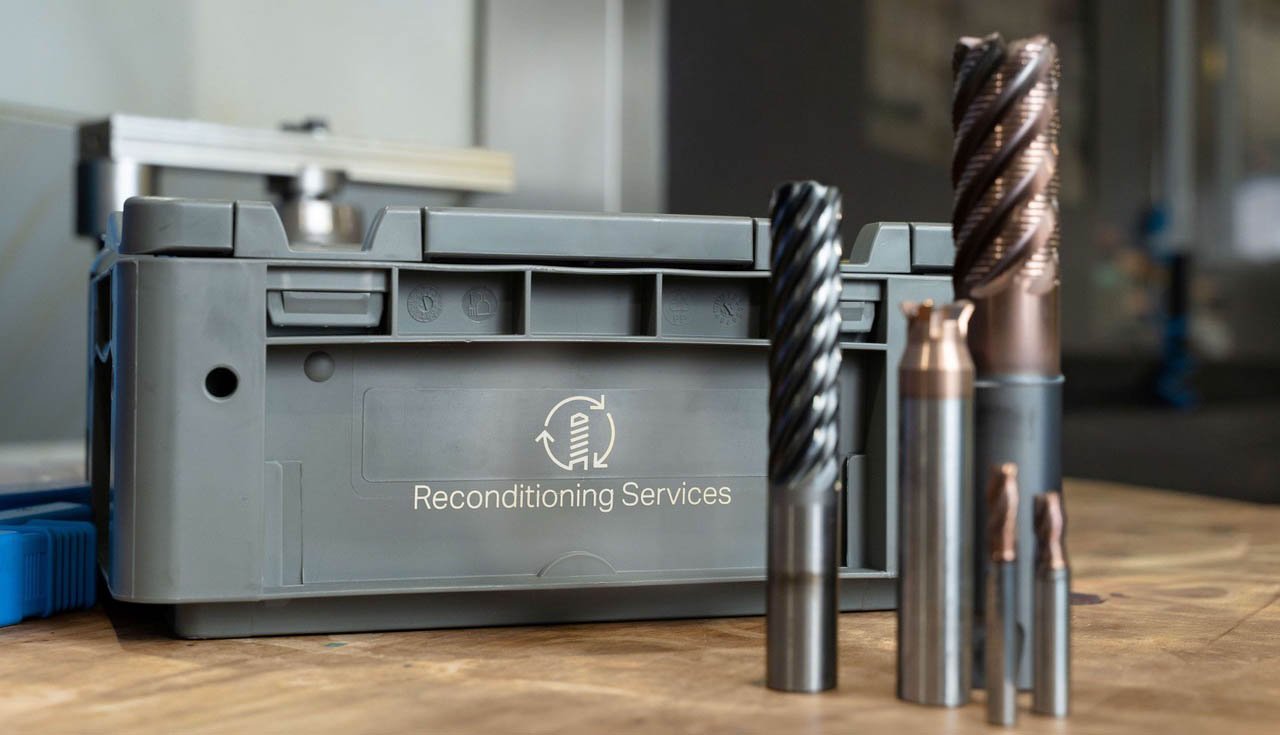
With a new update, Sandvik Coromant now offers an end-to-end experience for tool reconditioning
Metal cutting specialist and leading manufacturing solutions provider Sandvik Coromant has updated its solid carbide reconditioning service. To give manufacturers full visibility into the reconditioning process, this update, which replaces the previous multi-step, manual workflow, offers an integrated online experience that dramatically reduces quote and lead times.
Historically, customers requiring tool reconditioning had to rely on communication between sales teams, distribution centers, and designated hubs. Receiving a quote could take several days before the actual reconditioning could begin. Recognizing the need for a faster and more transparent process, Sandvik Coromant decided to simplify the customer journey by removing unnecessary steps from the service.
A new online portal transforms the process: now, customers simply register, enter the tool code and quantity of tools to be reconditioned, and receive an instant quote. This allows them to make immediate decisions and have a complete overview of the entire process. Furthermore, for most markets, Sandvik Coromant covers all shipping costs, taxes, and customs duties associated with the service, ensuring a simple and seamless end-to-end experience. On the platform, users can select their preferred packaging (either supplied by Sandvik Coromant or their own), add any notes to the order, and submit the request.
Once an order is placed, it can of course be tracked. The portal shows which of Sandvik Coromant's global remanufacturing hubs the tools will be sent to and provides direct contact information for the responsible team. Completed orders and remanufacturing history data are automatically stored, providing complete transparency to support ongoing production planning. Customers can also easily track the number of tool remanufacturing operations, allowing for better inventory planning.
"The goal is to achieve a consistent and reliable lead time of 21 days from order receipt," says Matthew Johnson, Product Manager – Reconditioning at Sandvik Coromant. "Customers will enjoy all the benefits of full process visibility, faster lead times, and complete confidence in the value of reconditioning. Our goal is to give them back control, while striving to meet the highest reconditioning standards."
Customers can choose to recondition their tools as often as they wish, as long as their quality meets their needs. "While we guarantee that the tools can be reconditioned up to three times and maintain 100% of their original performance, we know they can be reconditioned many more times and still deliver exceptional performance," Johnson continues.
Typically, reconditioning a tool at least three times saves 50% compared to purchasing new tools. This service is combined with Sandvik Coromant's tool recycling program, which is dedicated to tools that have reached the end of their useful life. This combination of an intuitive and transparent reconditioning service and a proven buyback program allows manufacturers to maximize the value of their equipment and move closer to achieving their sustainability goals.
Sandvik Coromant
Together with customers and partners, Sandvik Coromant paves the way to a sustainable future and provides tooling solutions to mechanical engineering industries worldwide. Over eighty years of practical experience have allowed us to build a wealth of knowledge in metal cutting and machining. This expertise transforms every challenge into an opportunity for innovation, collaboration, and cutting-edge solutions. Our goal is to pursue positive change by promoting sustainability, efficiency, and growth to shape a future where innovation is at the forefront. Part of the global industrial engineering group Sandvik, Sandvik Coromant is committed to building the future, together with its customers.
For more information, visit www.sandvik.coromant.com or follow us on social media.
Allegro microsystems introduces 48v power and precision sensor solutions for physical ai in humanoid
The new devices address critical challenges of size, weight, and safety in humanoid robots. Collaboration with Sarcomere Dynamics makes near-human dexterity possible.Allegro MicroSystems, Inc. (“Allegro”) (Nasdaq: ALGM), a leading global provider of power and sensor solutions for motion control and energy-efficient systems, expands its robotics portfolio with precision sensors and 48V power architectures. The new solutions address some of the key hardware challenges of Physical AI: torque density, thermal management, and functional safety in human-robot collaboration.Key innovations in the portfolio include: 48V power integration:The A81481 power management integrated circuit (PMIC) reduces overall system footprint and hardware costs by 50%, accelerating time to market for robotics OEMs.Precision in high-torque joints: The A17802 and A17803 inductive position sensors are immune to stray magnetic fields, requiring no additional shielding, and tolerate air gap variations. Dexterity in microjoints: The XtremeSense™ TMR CT310 angle sensor and the A33023 Hall-effect angle sensor offer sub-degree accuracy and are a compact alternative to traditional resolvers and optical encoders. “Precise motion control, accurate measurement, and efficient power management are critical for advanced robotic manipulation applications,” said Harpal J.S. Mandaher, CEO and co-founder of Sarcomere Dynamics Inc., said, “We are proud to collaborate with Allegro to integrate their advanced motion controllers, sensors, and power ICs into our Scorpion robotic gripper. This collaboration will continue with our next-generation ARTUS Dex, a 24-degree-of-freedom (DoF) robotic hand designed to deliver human-like dexterity in advanced physical AI applications.” Single-Chip PMIC Simplifies 48V Power Supply for RobotsHumanoid robots are increasingly adopting 48V architectures, which reduce wiring weight and limit resistive losses. Designers, however, face the challenge of safely stepping down higher voltages into very compact packages. Allegro addresses this need with the A81481 integrated circuit, drawing on decades of experience in the automotive industry. The A81481 is a 48V PMIC integrated into a single chip, designed for safety-critical robotic applications. It manages the power and safety functions of the entire system directly from a 48 V bus, without the need for external pre-regulators. The device integrates two buck (step-down) regulators, five low-dropout (LDO) outputs, and ASIL-D-compliant safety diagnostics, including a triple-watchdog architecture, all in a compact 6 × 6 mm package. The A81481 powers distributed sensor arrays and simplifies board layout. It also reduces both the overall system footprint and bill of materials (BOM) costs by approximately 50%. Sub-degree angular accuracy for smooth, natural motion. In high-torque actuators, such as those in shoulder, hip, and knee joints, the A17802 and A17803 inductive position sensors ensure precise and reliable measurements even under the most demanding motor control conditions. The A17803 sensor is also available in an ultra-compact QFN package. Thanks to on-chip compensation and advanced filtering techniques, both operate reliably across varying air gaps. Their inherent immunity to stray magnetic fields also eliminates the need for costly shielding. To meet the more stringent mechanical constraints of robotic hands and fingers, the XtremeSense™ TMR CT310 and Hall-effect A33023 sensors better withstand contamination, mechanical shock, and runout—factors that can compromise the performance of traditional encoders. The CT310 offers sub-degree accuracy in a 2 × 2 mm DFN package. The A33023 adds low latency, immunity to stray magnetic fields, and multiple digital output options, making it well-suited for applications requiring robust diagnostics and support for functional safety requirements. “For fixed-mount industrial robots, weight and space are less stringent because they can use larger cables, large external drives, and liquid-cooled systems,” said Andreas Friedrich, Senior Director of Technology & Strategy at Allegro MicroSystems. “In autonomous humanoid robots with more than 30 degrees of freedom, however, every gram and millimeter counts. We combine native 48V power management, robust motor and gate drivers, inductive sensors immune to stray magnetic fields, and compact TMR sensors, offering robot designers integrated, modular solutions ready to meet safety requirements. This allows them to maximize torque, manage tight mechanical tolerances, and achieve smooth motion.”
 Industriale.it certification